
Gagosian and Olney Gleason bring the Abstract Expressionist painter's first-ever French solo show, timed to a landmark Met retrospective placing her work in its rightful historical frame
This autumn, Lee Krasner arrives in Paris for the first time. Gagosian and Olney Gleason, in collaboration with the Pollock-Krasner Foundation, will present paintings and works on paper by the American Abstract Expressionist at Gagosian's gallery on rue de Ponthieu. It will be her first exhibition in France, and her first show with Gagosian.
The show opens October 19, two weeks after the Metropolitan Museum of Art in New York opens "Krasner and Pollock: Past Continuous," a major dual survey placing the two artists on equal footing. That Met exhibition is expected to bring together 120 works by both artists. Paris closes December 18.
The Paris presentation will bring together paintings and works on paper from the 1960s, a decisive decade in the artist's trajectory. The show traces a sharp arc within that period. By the end of the 1950s, Krasner's emotional turmoil confined her to work only at night under artificial light, conditions that brought her closest to Pollock's signature style, yet in her own posture of fiercely composed abstract forms, explosive brushwork, and a refined palette of umber, cream, and white. The "Umber Paintings" convey a distinctive rawness and intensity that was unprecedented in her oeuvre, and remain lauded as the artist's most psychologically evocative works.
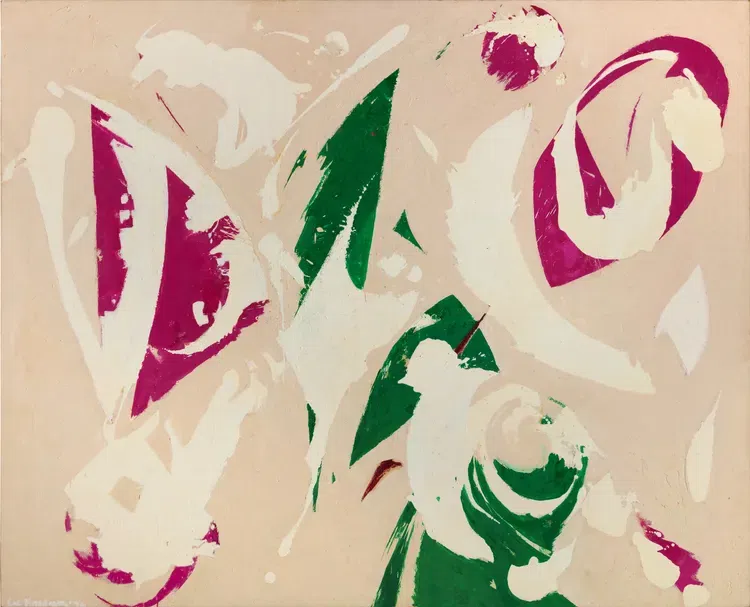
From there, her work shifted dramatically. In the early 1960s, Krasner began what she called her "Primary Series," a body of more than sixty paintings whose exuberant color marked a dramatic break from the umber palette, incorporating alizarin crimson, fuchsia pink, and hot orange, further cementing her reputation as, in one critic's phrase, "a good noisy colourist." These were brash, radiant works, sometimes at a thrillingly grand scale, produced after Krasner suffered an aneurysm in 1962 and broke her arm in 1963, emerging from both with renewed conviction.
Olney Gleason serves as the exclusive worldwide representative of Krasner's work via the Pollock-Krasner Foundation. Kara Vander Weg, a Gagosian senior director, initiated the collaboration after discussions with Larry Gagosian about collector interest in Krasner, connecting with Eric Gleason, who began working with the estate in 2016. Krasner "never had a show in France before, which is remarkable," Vander Weg noted.
Eric Gleason said the exhibition will "further illuminate Krasner's position as one of the most versatile and courageous painters of the postwar era." The show will include "Comet" (1966–70), an oil on canvas measuring 70 by 86 inches, held in the Pollock-Krasner Foundation's collection.
Krasner's first retrospective was staged in 1965 at the Whitechapel Gallery in London. A major touring retrospective followed in 2019, opening at the Barbican Art Gallery before traveling to Frankfurt, Bern, and Bilbao. A massive 1960 canvas, "The Eye Is the First Circle," sold for a record $11.7 million at Sotheby's that same year, with all ten of her top auction prices coming within the past decade.
Reflecting on her 1960s work in 1973, Krasner said: "My painting is so biographical, if anyone can take the trouble to read it." That frankness cuts to the core of what the Paris show asks viewers to reckon with. Only by the second half of the 1960s did critics begin reassessing her role in the New York School as a painter and critic who greatly influenced both Pollock and Clement Greenberg, having previously overlooked her because of her relationship with Pollock.
The timing now, with Paris and New York presenting her work simultaneously, suggests that reassessment has reached a different register entirely. Krasner's market is fast changing as she continues to gain well-deserved institutional recognition. The rue de Ponthieu show, opening a week before Art Basel Paris, positions her not as a rediscovery but as a fixed point of postwar American painting that certain institutional histories simply took too long to locate.
Follow topics and authors from this story to see more stories like this in your personalized feed and receive updates when new work is published.